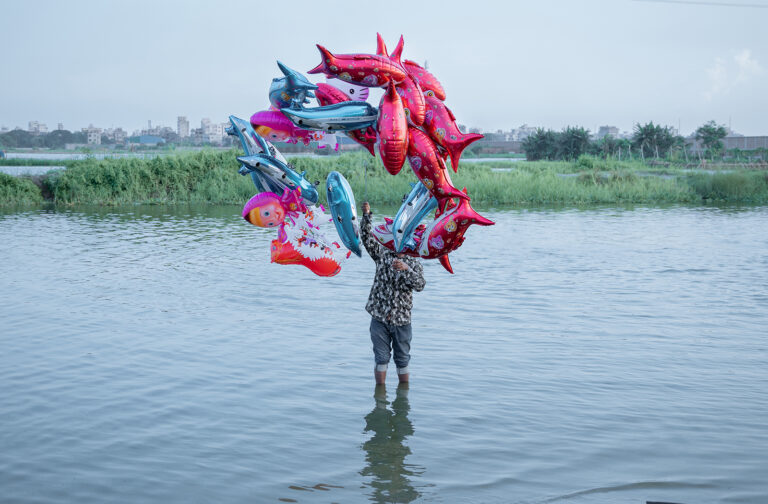
Jubair Ahmed Arnob is a documentary photographer based in Bangladesh whose work explores socio-environmental transformations and the quiet narratives that often remain unseen. His practice is informed by an anthropological lens, alongside a deep engagement with critical theory, psychoanalytic approaches, and sustained field-based research. This allows him to navigate the intersections of power, memory, ecological consciousness, and lived experience.
He built his photographic foundation at The VII Foundation and Counter Foto, developing both technical and conceptual rigor. To further expand his practice, he pursued specialized training, including the 01-to-01 Mentor Program & Foundry Photojournalism Workshop with VII Academy, GenGeo Storytelling for Impact: Photography from the National Geographic Society, and Introduction to Digital Journalism from Reuters.
Recently, his ongoing project “The Place Where I Used to Play” has been recognized with numerous honors, including the Student Photographer of the Year award at the Sony World Photography Awards 2026, the Royal Photographic Society Documentary Photography Award 2025 (Winner), CPOY 2025 (Gold), and the Lucie Scholarship Grant 2025 (Honorable Mention), among others. He was also named Runner-up at the Joop Swart Masterclass 2026, and has received grants from Photographers Without Borders and the Alexia Foundation Student Award, presented at the Festival della Fotografia Etica. His work has been featured at prominent festivals, including Les Rencontres d’Arles and Stirling Photography Festival, and exhibited at venues such as Somerset House (UK), McDougall Center Gallery (USA), and Museo Diocesano Carlo Maria Martini (Italy), among others. He has exhibited nationally and internationally, with presentations across the United Kingdom, the United States, France, Germany, Italy, Greece, India, Japan, and Thailand. Jubair’s work has been published in the New York Times, Forbes, the Guardian, The Telegraph, Stern, Der Spiegel, and many other international publications.
Rooted in lived experience and long-term observation, his work spans themes of climate change, migrant workers, and environmental transformation. Through sustained observation, he seeks to preserve what is fading, question what is transforming, and reveal the emotional terrains shaped by changing environments and displacement.