
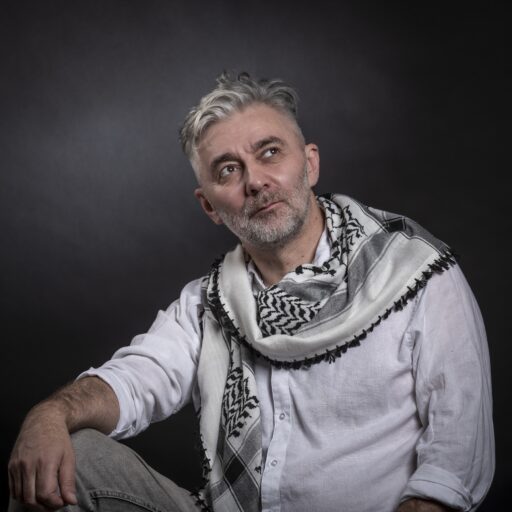
Nihad (Muhamed) Kreševljaković was born in Sarajevo in 1973, where he completed the First Gymnasium and graduated from the Faculty of Philosophy, Department of History.
He began writing at the age of eighteen, publishing various texts—primarily on historical topics—in different Bosnian and Herzegovinian newspapers. As a contributor to the program “Sarajevo Calling,” he was part of the editorial team of Omladinski Radio (Youth Radio Sarajevo), where he also produced segments on the history of Sarajevo.
During the siege of Sarajevo, he was engaged with the Professional Fire Brigade Sarajevo and the Information Center. In the same period, together with his twin brother Sead and a group of friends, he co-founded the independent production company “Save the Amazon,” documenting the daily lives of Sarajevo’s citizens during the siege. From 1991 to 1994, he also worked as an occasional contributor for RTV Hayat, producing features on the history of the city.
Since 1994, Kreševljaković has worked with the International Theatre Festival MESS, first as a collaborator and soon after as a program manager. In 2004, he became the Festival’s Executive Producer. In 2011, he was appointed Director of the Sarajevo War Theatre (SARTR), and in 2016 Director of the Public Institution MESS, a position he continues to hold.
Toward the end of the war, in 1995, he participated in the creation of the Modul Memorije (Memory Module) program, one of the key programs of MESS, which explores the culture of remembrance through art. Since 2002, he has served as its Artistic Director. The program examines the relationship between radical experiences and art, with a particular focus on works created in Bosnia and Herzegovina during the war.
As a documentary filmmaker, Kreševljaković co-authored the film “Greta,” directed by Haris Pašović, and “It Is Night. We Illuminate,” directed by Jasmila Žbanić. He independently directed TV documentaries including “Gazi Husrev-beg,” “From Auschwitz to Sarajevo,” and “Sevdalinka,” among others. After the war, together with his brother Sead and Nedim Alikadić, he co-created the cult documentary “Do You Remember Sarajevo” (2002), as well as “In Search of the Land of Freedom – Un musulmano in San Marino” (2004), “From Shelter to the Sarajevo War Theatre” (2012), and “Susan Sontag in Sarajevo.” As a producer, he also signed the documentary “May 2 – It Was a Beautiful and Sunny Day.” He is one of the authors of the film “60 Years of MESS.” He directed and authored the documentary “Don’t Cry for Me Sarajevo – Susan Sontag in Sarajevo” (2019), about the production of “Waiting for Godot” directed by Susan Sontag during the siege, as well as “The Strength of the Spirit,” a story about returnees to Kozarac near Prijedor.
As a theatre producer, he has worked on numerous productions, including: “Fear and Misery of the Third Reich – 99%” (director Nermin Hamzagić); “It Was a Beautiful and Sunny Day” (Tanja Miletić Oručević); “Happy End” (Pjer Žalica); “The Secret of Raspberry Jam” and “Concert with a Walnut, Hammer and Fez” (Selma Spahić); “Animal Farm” (Dino Mustafić); “Flour in the Veins” (Boris Liješević); “Finger” (Sabrina Begović); “King Lear” (Diego de Brea); “The Caucasian Chalk Circle” (Paolo Magelli), and many others. He has also participated in major theatre projects in Sarajevo, Milan, Amsterdam, and New York.
He is the author of numerous literary and professional works published in journals such as Lica, Odjek, and Beharistan.
He is a regular contributor to the Al Jazeera Balkans portal and has authored texts for photo monographs including “Sarajevo – A Place of Encounter,” “Muslims in New York,” “The Tunnel of Hope,” and “The Map of Survival.” He contributed to the book “The Encyclopedia of the Siege of Sarajevo” (FAMA) and participated in FAMA projects such as “Life – Citizens of Sarajevo” and “The Siege 92–95.” He is the author of the book “At the Helm of the City,” on the history of Sarajevo’s mayors, and editor of the monograph “Modul Memorije – 30 Years.”
He is also editor and contributor to the monograph of the City of Sarajevo, published in 2020.
He has edited and published books including: “May 2 – It Was a Beautiful and Sunny Day” (a collection of texts and memories from the siege period); “My Name is Rachel Corrie” by Catherine Winer and Alan Rickman; “Styles of Radical Will” by Susan Sontag; “Women of Besieged Sarajevo” by photographer Hidajet Delić; “Theatre in War 1992–1995” by Davor Diklić; “Shadow of Memory” by Ron Haviv and Loren Walsh; “Srebrenica – 25 Years Later”; novels “Do You Know Nunu Montiljo” and “The Suitcase People” by Edin Krehić; and the theatre studies book “Theatre Under Siege” by Hana Bajrović, among others. Together with a group of colleagues, he co-founded the citizens’ association “Video Archive – Hamdija Kreševljaković Library,” dedicated to the preservation and promotion of Bosnia and Herzegovina’s cultural and natural heritage.
Since 2009, he has also served as Honorary Cultural Attaché of the Embassy of the Republic of San Marino in Bosnia and Herzegovina.
He is the recipient of one of Europe’s most prestigious awards, the KAIROS Prize (2019), as well as the “Radoslav Zoranović” Award for contributions to the development of theatre arts in Bosnia and Herzegovina.
Since the 2023/2024 academic year, he has been a lecturer at the Academy of Performing Arts in Sarajevo, teaching the course “Theatre Under Siege.”